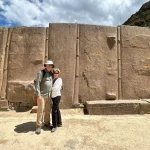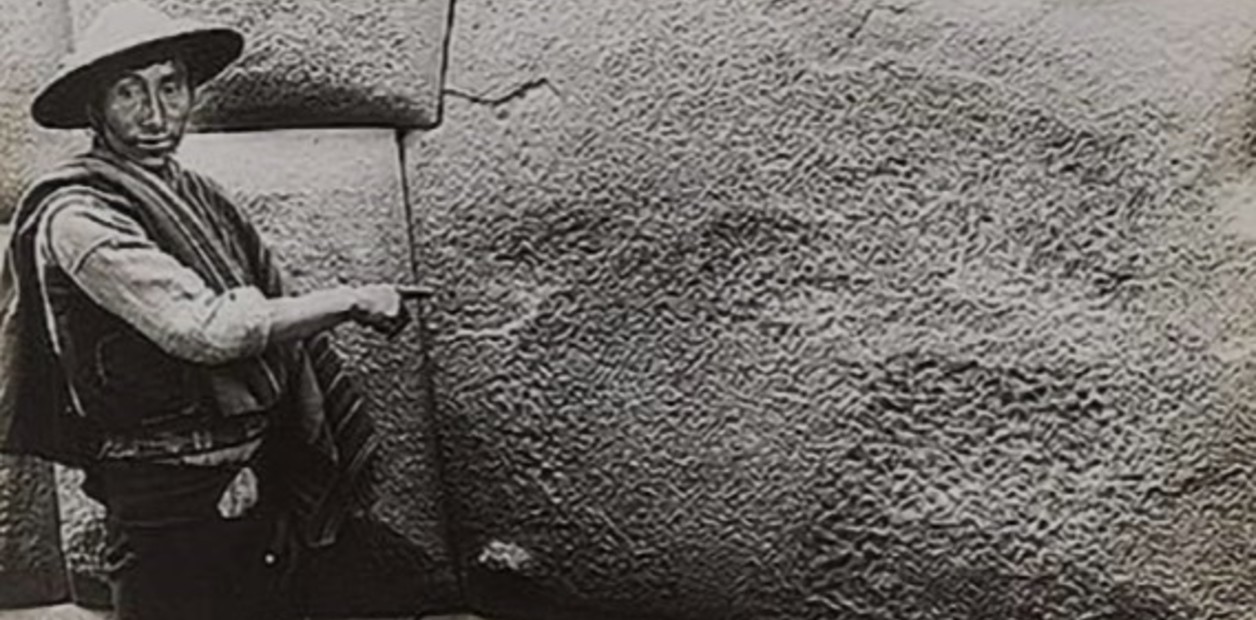
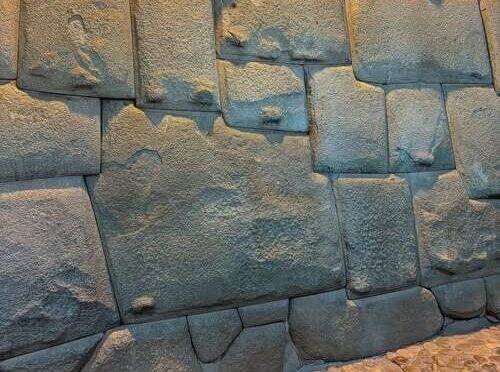
The 12-Angled Stone and its meaning represent one of the greatest mysteries of Inca architecture in Cusco. Upon observing it, you will notice that its perfect fit symbolizes the political power and technical mastery of the ancient inhabitants of the Andes. That is why, at Trails to Machu Picchu, we recommend that you dedicate some special time to it during your walk through the historic center.
History and origin of the Palace of Hatun Rumiyoc
This impressive structure was the base of the palace of Inca Roca, the sixth ruler of the Tahuantinsuyo. Furthermore, as you walk along Hatunrumiyoc street, you will feel that its stones narrate the history of a civilization that dominated the mountainous terrain. Thanks to its solidity, this wall has withstood earthquakes and invasions over the centuries.
Historical link to Inca Roca
The palace was built during the 14th century as the official residence of the panaca or royal family of this ruler. We tell you that the location was not chosen at random, as it is found on a sacred axis of the city. For this reason, you will notice that the quality of the carving is far superior to that of other common dwellings.
After the Spanish conquest, the upper part of the palace was modified to build a colonial mansion. Even so, you will observe that the Inca foundations remained intact due to their incredible resistance. Currently, the building functions as the Archiepiscopal Palace, but you can still admire the original base from the street.
From Inca palace to colonial mansion
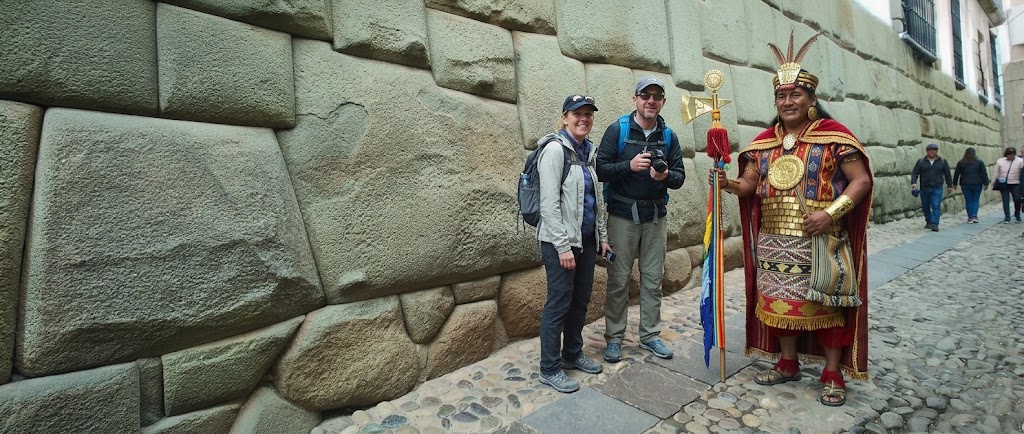
The transition between the Inca and Spanish styles is evident when you look toward the upper part of the wall. You will see how the rectangular stones of the base support white walls with carved wooden balconies. This architectural mix allows you to understand the process of cultural mestizaje that Cusco experienced.
- You will notice that the Inca wall uses large stones with irregular shapes.
- You will observe that the upper colonial constructions employ lighter materials such as adobe.
- You will feel the contrast between the austerity of the stone and the ornamentation of the balconies.
Cultural symbolism of the twelve angles
Many travelers wonder what exactly the precise edges of this stone piece represent. For the Incas, perfection in construction was a way to honor the divinities and demonstrate order. For this reason, at Trails to Machu Picchu, we consider that this stone symbolizes the unity of the empire.
Representation of the royal families
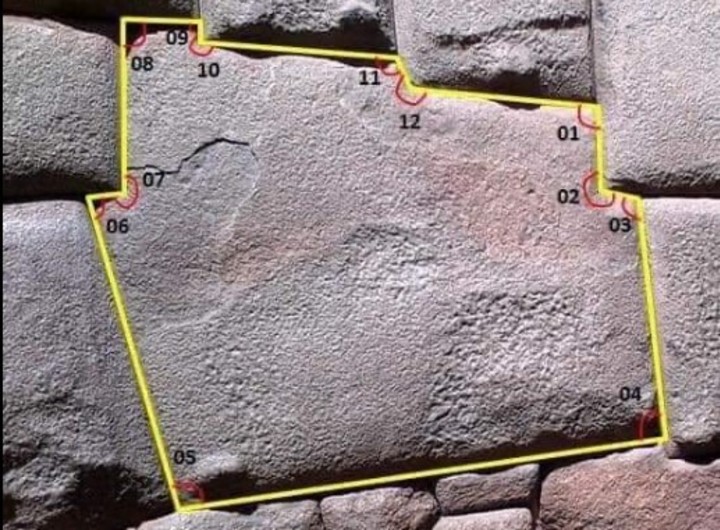
One of the most accepted theories suggests that the twelve angles represent the twelve royal panacas of Cusco. According to researchers from the National University of Saint Anthony the Abbot in Cusco in a 2021 report, each angle symbolizes a lineage. Thus, the stone would act as a link that keeps all the Inca nobility united.
Upon observing the piece, you will notice that each angle fits with another neighboring stone in a millimetric way. This reinforces the idea that Inca society depended on the close collaboration between all its members. Therefore, the stone is not just a decorative object, but a message of political stability.
Connection with the calendar and astronomy
Another interpretation relates the angles to the twelve months of the year or the twelve signs of the Andean zodiac. Investigations published in the Journal of Peruvian Archaeology in 2022 propose that the wall functioned as a solar marker. In practice, this means that you are looking at a tool that helped to organize agricultural campaigns.
- The twelve angles could mark the lunar cycles important for planting.
- The sunlight strikes each edge differently depending on the time of year.
- We suggest you notice how the shadows change if you visit the site at different times.
Technical characteristics and precision of the fit
The technique used to create this piece is known as cellular or polygonal style architecture. You will notice that no type of mortar or cement was used to join the rock blocks. Thanks to this large-scale jewelry work, you will not be able to insert even a sheet of paper between the joints.
Carving techniques on green diorite stone
The rock used is green diorite, an extremely hard material that abounds in the vicinity of the valley. You will be surprised to know that the Incas did not use iron tools to shape these stones. Instead, they used harder stones and water to wear down the surface until achieving the desired fit.
A petrographic analysis carried out in 2023 by the Geological, Mining and Metallurgical Institute highlights the high density of this material. This characteristic allows the stone to withstand enormous pressures without breaking or deforming over time. For this reason, you will notice that the surface remains smooth and with its edges defined.
Seismic resistance of Inca walls
Inca walls are famous for their ability to dance during teluric movements without collapsing. You will see that the 12-angled stone is surrounded by blocks that act as a flexible puzzle. This engineering prevents seismic waves from concentrating all their energy on a single point of the wall.
Trapezoidal structure
You will notice that the walls have a slight inward inclination, which improves their center of gravity. This design is fundamental for the structure to remain standing during high-magnitude earthquakes.
Gravity fit
The stones are held together solely by their own weight and the precision of their cuts. During an earthquake, the blocks move slightly and then settle back into their original position. Thanks to this, you can walk today along a street that has survived significant natural disasters.
How to visit the 12-angled stone
Visiting this site is simple because it is located in a very busy pedestrian area of the city. You should know that you do not need to pay any entrance fee, since the wall is exposed in the open air. Even so, we recommend you follow our suggestions so you can enjoy the experience without any setbacks.
Exact location on Hatunrumiyoc street
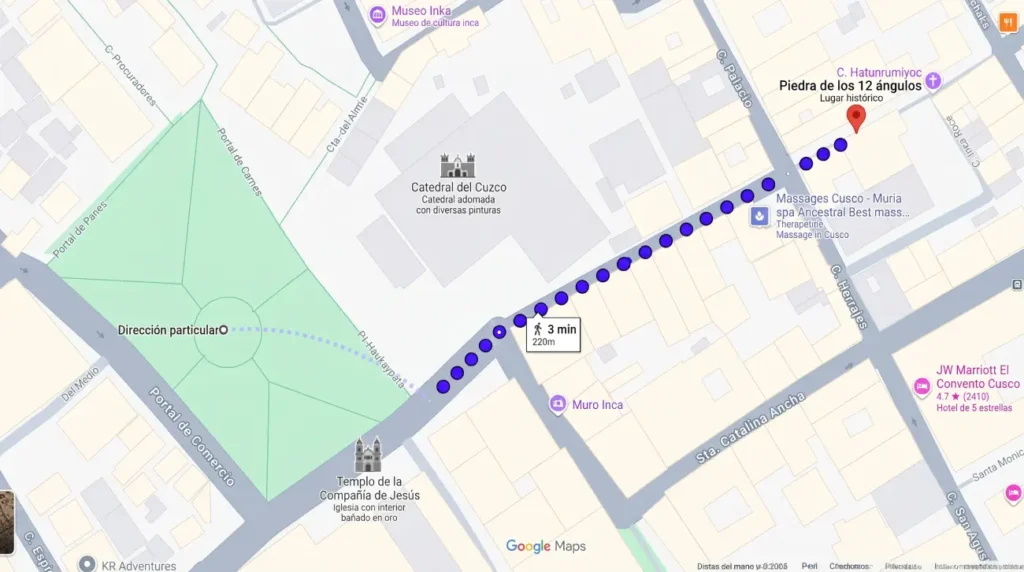
You will find the wall on Hatunrumiyoc street, just a few steps from the famous 7-Angled Stone. This thoroughfare connects the Plaza de Armas with the picturesque San Blas neighborhood. We recommend you wear comfortable footwear, as the street stones are usually slippery when it rains.
- Locate yourself at the right corner of the Cusco Cathedral.
- Go up Triunfo street, which is the direct continuation toward the northeast.
- Continue straight until the street changes its name to Hatunrumiyoc.
- Look for the wall on the right side, where you will notice a small crowd of people taking photos.
Best time to photograph the wall
Sunlight plays a crucial role for you to manage to capture all the details of the stone. We suggest you go early, around 7:00 in the morning, to avoid the constant flow of other travelers. At Trails to Machu Picchu, we prefer the afternoon hours to see the shadows elongated over the diorite.
- Avoid the midday hours because direct sunlight can flatten the reliefs of the angles.
- Consider a night visit, as artificial lighting highlights the depth of the joints.
- Be patient, as it is the most photographed point in the city and there are always people waiting.
Walk from the Plaza de Armas
The walking route is short but full of history with every meter you advance along the street. You will notice that the atmosphere changes as you move away from the center of the plaza toward narrower streets. On this path, you will see fine craft shops and art workshops that keep the Cusco tradition alive.
Take advantage of the walk to observe other Inca walls that serve as a base for current houses. You will realize that the 12-Angled Stone and its meaning are part of a larger complex. If you pay attention, you will notice that the entire street is an open-air gallery of ancient engineering.
Conservation rules for tourism
Caring for this heritage is the responsibility of all of us so that future generations can also admire it. For this reason, the Ministry of Culture has established strict rules that you must respect during your visit. You will notice that there is always a guard or security personnel supervising the area to avoid damage.
Prohibition of touching the stone
It is strictly prohibited to touch the stone with your hands or any object that could damage it. We tell you that the natural oils of the skin and sweat cause chemical wear on the surface. If many people touch it, the stone will lose its original color and its edges will become blunt over time.
- Always respect the security cordon that usually surrounds the most sensitive area of the wall.
- Avoid leaning on the wall to take photos or rest during your walk.
- Remember that any damage to archaeological heritage is punishable by Peruvian laws.
How to contribute to the preservation
You can help us preserve this site simply by being a conscious and respectful visitor. If you see another person attempting to touch the stone, we suggest you kindly inform them about the importance of not doing so.
In addition, we recommend you not to throw trash in the surrounding streets or make graffiti on the ancient structures. These small actions ensure that Hatunrumiyoc street continues to be a clean and welcoming place. Thanks to your collaboration, we keep the magic of Cusco intact for everyone who visits us.
Other Inca walls to visit nearby
Once you have admired the famous stone, you can explore other examples of Inca architecture a few minutes away. Cusco is full of hidden treasures that will allow you to compare different construction styles. We suggest you extend your walk to learn more about the evolution of these ancient techniques.
Loreto street and Intikijllu
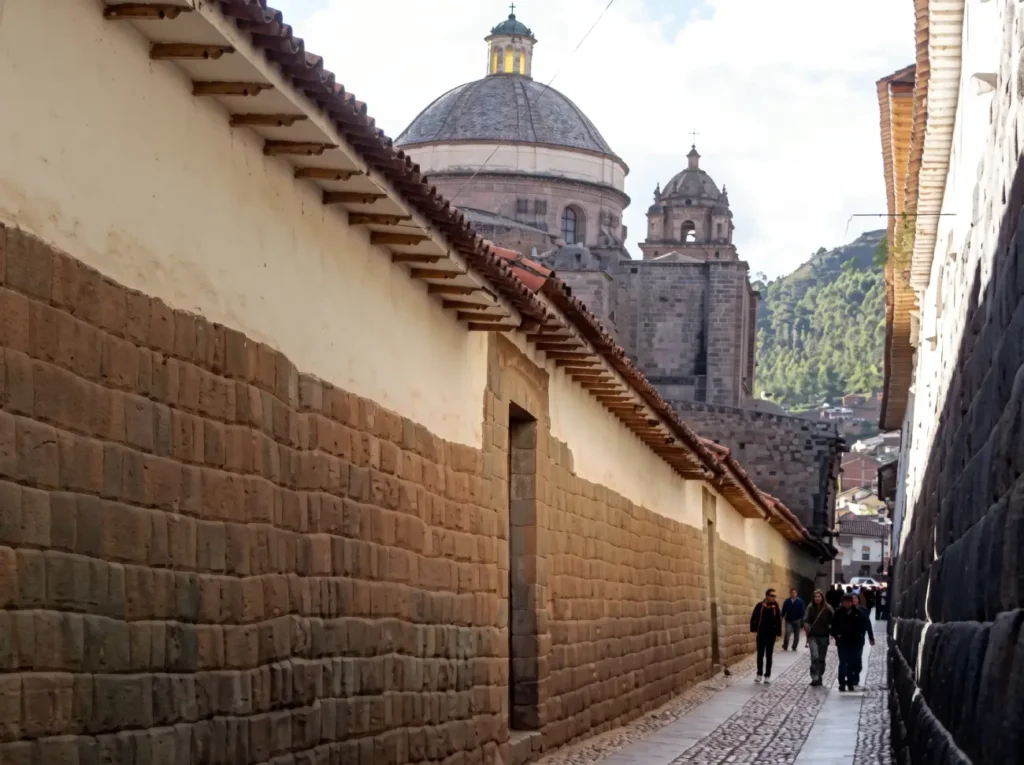
This street is known for having the longest and best-preserved walls from the Inca period. You will find the wall of the Acllahuasi or House of the Virgins of the Sun on the left side. You will notice that these stones are smaller and more uniform than those of the 12-angled stone.
- You will observe the imperial style, where the rectangular blocks fit with perfect symmetry.
- You will feel the narrowness of the street, which maintains the original layout of the pre-Hispanic era.
- You will be able to see the contrast with the Amaru Cancha wall, located just opposite.
The Siete Culebras street wall
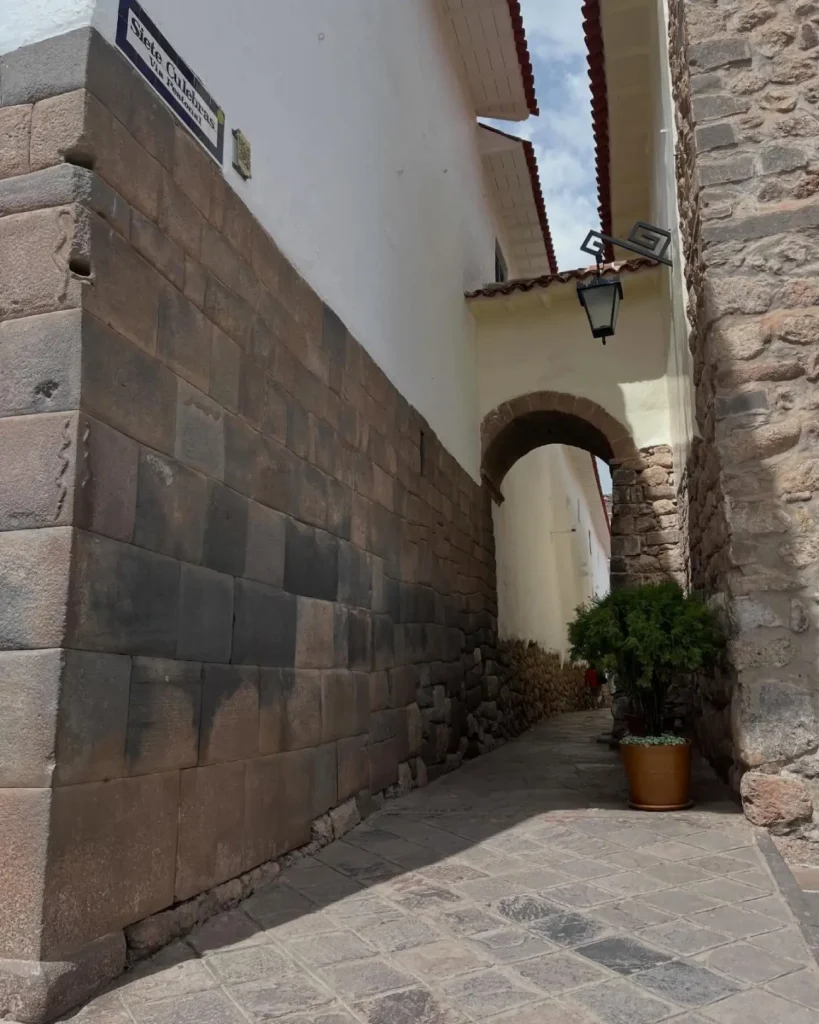
Near Plaza Nazarenas, you will find a wall with carved reliefs that represent small snakes. We recommend you look for these figures, as they are rare examples of figurative carving on exterior walls. This visit complements your route very well after seeing the 12-Angled Stone and its meaning.
At the end of your walk along these streets, you will have understood why the Incas are considered masters of stone. At Trails to Machu Picchu, we organize guided tours through these areas to explain every historical detail to you. Thus, your trip through the capital of the empire will be an educational experience filled with unforgettable moments, contact us.